
This post may contain affiliate links. I only recommend products I use and love. Read the full disclosure here
Updated on: September 23, 2026
Originally published on: September 23, 2026
You ate. You weren’t skimping, either. Maybe you had a sandwich, a bowl of soup with crackers, or the leftover pasta from Tuesday, and it took real time out of the middle of your day. Yet even some seemingly healthy lunch ideas can leave you standing in front of the pantry around 2:15, door open, not hungry in a way you could name out loud, but looking for something anyway.

It’s easy to assume that afternoon trip to the pantry is a discipline problem. Usually, it isn’t. When hunger returns quickly after a real meal, it can have more to do with what was on the plate than how much willpower you have.
Two lunches with identical calorie counts can leave you feeling completely different a few hours later because the composition of those meals affects how quickly they’re digested and how steadily they provide energy.
The Afternoon Crash Is Often About What You Ate
Research has demonstrated just how differently similar meals can affect hunger.
In one crossover trial, teenage boys ate test meals matched for calories, macronutrients, fiber, and even palatability. The primary difference was how quickly the carbohydrates affected blood sugar.
During the five hours following the high-glycemic meal, the participants voluntarily ate 53% more food than they did after the medium-glycemic meal and 81% more than after the low-glycemic meal.
In other words, the meals contained the same calories, but they didn’t have the same effect afterward.
One proposed explanation involves the speed at which carbohydrates are absorbed. Rapid absorption can cause a sharper insulin response, followed by a drop in circulating fuel levels a few hours later. Your body doesn’t announce that you’re experiencing a blood sugar curve. It simply makes that granola bar in the pantry suddenly look awfully appealing.
Foods such as white bread, white rice, many crackers, and regular pasta fall toward the faster-digesting end of the carbohydrate spectrum. That doesn’t make them bad foods. The problem is more likely to occur when they make up most of the meal without enough protein, fiber, or fat alongside them.
Your Lunch May Need More Protein
Most Americans get enough protein over the course of an entire day. The problem is that we don’t necessarily spread it evenly across our meals. Dinner often gets the largest share, while breakfast and lunch can be comparatively light.
That distribution may matter.
In a 12-week randomized trial involving young adults, participants who ate a breakfast containing 35 grams of protein reported less daily hunger and did not gain body fat during the study period. A version of the meal containing 13 grams of protein did not produce the same effects.
The gap between protein quantity and daily hunger ratings appeared at the higher dose, not the lower, suggesting that a modest sprinkle of protein doesn’t do much.
The difference suggests that simply adding a small amount of protein may not be enough to noticeably affect hunger.
For lunch, that means looking at protein as a substantial part of the meal rather than an afterthought. Options might include chicken, eggs, Greek yogurt, tuna, lentils, or another filling protein source.
For example, a few ounces of turkey tucked into an otherwise carbohydrate-heavy lunch may not keep you satisfied for very long. A meal built around a more substantial serving of protein, along with fiber and fat, is more likely to have staying power.
Fiber Helps Your Lunch Stick With You
Fiber is another important part of a satisfying lunch. It adds bulk and slows digestion, helping moderate how quickly the carbohydrates in a meal affect blood sugar.
Unfortunately, many adults aren’t getting enough of it.
USDA survey data puts average dietary fiber intake among U.S. adults at around 16 grams per day. That falls well below adequate intake targets of 25 grams for women and 38 grams for men.
The good news is that increasing fiber at lunchtime doesn’t have to involve specialty foods or complicated recipes.
A cup of black beans contains around 15 grams of fiber, while a cup of raspberries provides about 8 grams. Other easy options include avocado, a pear with the skin left on, cooked barley, vegetables, lentils, and nuts.
Adding even one or two higher-fiber foods to a lunch you already enjoy can make a substantial difference without requiring you to completely change what you eat.
Don’t Automatically Remove the Fat
Protein and fiber tend to get plenty of attention when people talk about filling meals. Fat is more complicated because many of us spent years being taught that it was the part of lunch we were supposed to eliminate.
Think fat-free dressing, egg whites without the yolks, dry sandwiches, and salads with everything flavorful removed.
But fat digests slowly and can help a meal stay with you longer. Removing it completely may leave you with a lunch that simply doesn’t provide much staying power.
A dry salad is a good example. Vegetables can provide valuable nutrients and fiber, but a bowl consisting primarily of vegetables with no meaningful source of protein or fat may leave you hungry again surprisingly quickly.
Avocado provides an easy example of how fat and fiber can work together. A serving of approximately one-third of a medium avocado, or 50 grams, contains about 80 calories, 3 grams of fiber, and 6 grams of fat.There is also interesting population research surrounding avocado consumption. An analysis of National Health and Nutrition Examination Survey data involving 27,684 U.S. adults found an association between avocado consumption and lower body weight. Avocado consumers averaged 7.5 pounds less in body weight and had waist measurements approximately 1.2 inches smaller than non-consumers.
That doesn’t prove that eating avocado causes weight loss. It is an association found within a large survey population, and many other dietary and lifestyle factors may be involved. Still, avocado is one convenient way to add both fiber and fat to a meal.
Other simple choices include olive oil on vegetables, cheese on a sandwich, nuts added to a salad, or keeping the yolk in your eggs.
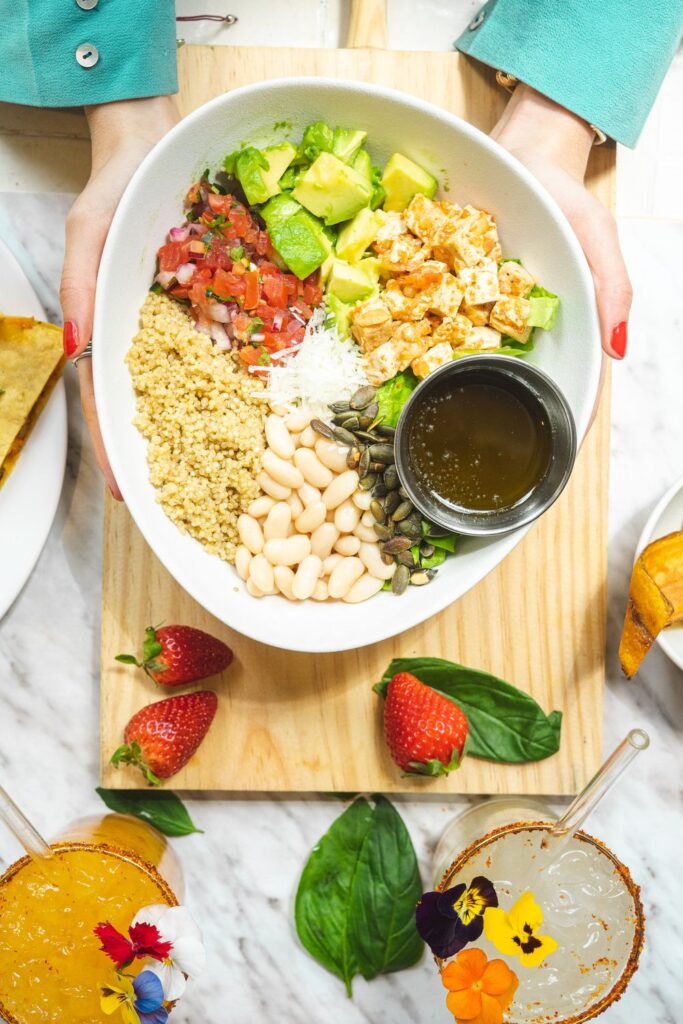
What Does a Filling Lunch Actually Look Like?
You don’t need an entirely new diet or a collection of complicated recipes. The goal is simply to make sure the major components show up together.
A practical lunch might include a substantial source of protein, plenty of vegetables or fruit, a source of fat, and a slower-digesting carbohydrate if you want one.
A Thai chicken salad with honey-lime dressing is one example. Sautéed chicken served over shredded cabbage and peppers provides protein and fiber, while a flavorful dressing made with ingredients such as lime, fish sauce, and ginger turns it into an actual meal rather than a bowl of vegetables you’ll regret an hour later.
If assembling lunch in the middle of the day is unrealistic, meal prepping can make this much easier. Several meal-prep combinations built around ingredients such as salmon, couscous, sweet potatoes, chicken, and stir-fried vegetables can provide roughly 37 to 44 grams of protein per serving.
You can also improve lunches you already make with a few inexpensive swaps. Try brown rice or barley instead of white rice, stir beans into soups or grain bowls, add avocado or olive oil to a salad instead of choosing a fat-free dressing, or eat whole fruit with the skin rather than replacing it with juice.
Small changes can alter the overall balance of a meal without requiring you to abandon foods you already like.
Sometimes Your Lunch Isn’t the Problem
Of course, food isn’t the only reason you might hit a wall in the afternoon.
Lack of sleep can affect appetite the following day. If you slept five hours the night before, that 2 p.m. slump may have as much to do with exhaustion as it does with lunch.
Hydration is another simple factor worth considering. Thirst and mild dehydration can sometimes be mistaken for vague hunger, so drinking a glass of water is an easy thing to try before automatically reaching for a snack.
And sometimes lunch really was just too small.
If you’ve been deliberately reducing portions and find yourself ravenous at 3 p.m. every single day, no combination of protein, fiber, and fat can compensate indefinitely for simply not eating enough food.
There’s also another possibility: you may not actually be hungry.
Mid-afternoon is when attention starts fading for a lot of people. Getting up, walking into the kitchen, and finding something to eat provides a convenient break from whatever you’ve been doing. What feels like a snack craving may occasionally be boredom, habit, or simply your brain asking for a few minutes away from work.
More fiber isn’t going to fix that one.
Build a Lunch That Gets You Through the Afternoon
If the same pattern happens every day, you eat a real lunch and then find yourself hungry again surprisingly soon, start by looking at the meal itself rather than blaming your willpower.
Make sure there is a meaningful source of protein on the plate. Add foods that provide fiber instead of stripping them away. Include enough fat to help make the meal satisfying, and consider swapping some rapidly digested carbohydrates for options that provide steadier energy.
You don’t need a perfect lunch, and you certainly don’t need to turn every midday meal into a nutrition project. You just need a meal substantial enough to do its job.
When protein, fiber, fat, and carbohydrates are working together, there’s a much better chance that lunch will actually feel like lunch instead of the opening act for whatever you find in the pantry at 2:15.